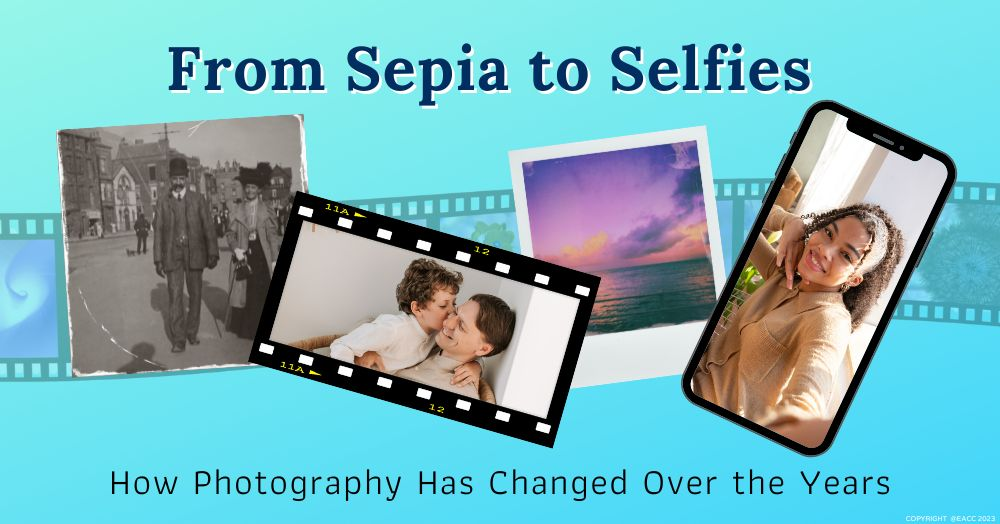
From Sepia to Selfies – How Photography Has Changed Over the Years
To tie in with World Photography Day, this community interest article examines how photography has changed over the years.
As it’s World Photography Day tomorrow (19 August), we look at how the camera and its role in society has changed over the past 200 years.
Brits do it five times a day, while Americans manage it 20 times a day.*
Yes, taking a photograph has become second nature for many of us who snap our pets, holiday destinations, dinner or ourselves without a second thought.
Across the world, people take a dizzying 1.81 trillion photos annually and share 1.3 billion photos on Instagram and 6.9 billion on WhatsApp daily.**
This is thanks to the high-spec cameras in our phones that mean we can easily capture all of life’s significant (and mundane) moments and share them in seconds.
It’s all a stark contrast to what the pioneers of photography went through in the 1800s. Back then, taking a single image took hours, required specialist equipment and involved handling toxic chemicals such as mercury.
A major breakthrough came on 19 August 1839, when Louis Jacques Mandé Daguerre revealed the secrets of his revolutionary image-making process to the world. The moveintroduced photography to the masses and put many portrait painters out of business.
Later came the roll-film Kodak camera (1888), the box Brownie (1900), the Polaroid (1948) and the digital camera (first sold commercially in 1987).
And then, in 1999, the digital camera was incorporated into the mobile phone – a development that revolutionised how we see the world.
As a result, our hunger for imagery has never been stronger, and we expect it to be high quality.
Gone are the days when we’ll excuse a grainy, out-of-focus photograph. This is worth bearing in mind if you plan to market a property; good lighting and careful positioning can make all the difference.
We’d love to see some of your best snaps. Whether it’s a brilliant landscape or a photo of your beloved pet, share them with us on our socials.
Here at Shaws Kensington, we take photography seriously, which is why we invest time and care into getting high-quality photographs to market properties. To learn more, read our previous blog guide to property photography.
* Source: Phototutorial
** Source: Phototutorial